
Introduction – Choosing the Wrong Food Container Mould Can Cost Your Business
In the food packaging industry, product quality and production speed are extremely important. But many businesses face problems because they choose the wrong Plastic Food Container Mould.
Common mistakes buyers share with us:
A low-quality mould can affect your product quality and customer trust. That’s why selecting the right Plastic Mould Manufacturer is important for long-term business success.
Step 1 – Define your food product requirements clearly
Before contacting any Plastic Die maker, you need to be completely clear about your product requirements.
Four questions to answer before you order any food container mould
1 – Hot food, cold food, or ambient storage? What temperature range?
2 – Does the container need a lid, tamper seal, or snap-fit closure?
3 – Annual production volume — how many pieces per year or per month?
4 – Printed label, IML decoration, or plain container?
Your answers directly determine which resin is appropriate, which mould steel grade to use, and what cavity configuration gives you the best cost-per-part at your target volume. Skipping this step is the most common reason buyers end up retooling within 12 months.
Step 2 – Choose the right food-grade plastic resin
Not all plastics are food-safe. And not all food-safe plastics behave the same way inside a Plastic Injection Moulding Machine. The resin you choose affects cycle time, wall thickness, shrinkage, and whether your container meets BIS or FDA food-contact compliance standards. Here are the four most commonly used resins in plastic food container mould manufacturing:
PP – Polypropylene
Food-safe, heat-resistant up to 120°C. Ideal for microwaveable boxes, tiffin containers, and Plastic Lunch Box Moulds. Excellent clarity and flexibility
HDPE – High-Density PE
Best for dairy containers, butter boxes, and products needing structural rigidity. Great for Plastic Storage Container Moulds
PET – Polyethene Terephthalate
Transparent finish perfect for salad packs, deli trays, and Plastic Food Container Moulds, where visible contents drive purchase
PS – Polystyrene
Lightweight and low-cost. Used for Ice Cream Cup Moulds, foam trays, and cold-storage disposables. Not suitable for hot food applications
At Hitbhav Mould, our engineering team confirms resin compatibility, mould steel grade, and shrinkage compensation calculations during the DFM review so your final container dimensions match your specification exactly.
Step 3 – Understand the types of plastic food container moulds
The phrase plastic food container mould covers a very wide range of tooling. Understanding which type fits your product and volume is critical before requesting a quote from any Custom Plastic Mould Manufacturer.
Standard injection mould – 50,000 – 1M+ shots
Best for tubs, boxes, trays. Most reliable option for medium-to-high volume Food Packaging Mould production
IML Container Mould – 100,000 – 1M+ shots
In-mould labelling for high-quality printed packaging. Ideal for FMCG brands competing on shelf presence
Thin-wall mould – 500,000 – 2M+ shots
For Plastic Coffee Cup Moulds, disposable lids, and ultra-lightweight containers. Extremely fast cycle times
Multi-cavity mould – 2M+ shots/year
4, 8, or 16 cavities per shot. Maximum output efficiency for large-volume Disposable Products Mould runs
Plastic Meal Tray Mould – 50,000 – 500,000 shots
Airline catering, hospital, school, and event catering. Multi-compartment design requires careful gate and cooling layout
Prototype mould – 5,000 – 50,000 shots
Aluminium or semi-steel. Lower upfront cost. Launch your product, validate the design, then scale to a full steel Custom Plastic Mould
Step 4 – Single cavity vs multi-cavity: which is right for your output?
| Factor | Single Cavity Mould | Multi-Cavity Mould (4–16) |
| Upfront Mould Cost | Lower | Higher |
| Cost Per Part | Higher | Much Lower |
| Best Annual Volume | Below 100,000 pcs | 200,000 pcs and above |
| Design Flexibility | Easy to modify | Harder to change after build |
| Machine Requirement | Smaller tonnage machine | Higher clamping tonnage |
| Ideal For | New product launch and testing | Established high-demand products |
Hitbhav Mould’s complete food container mould range
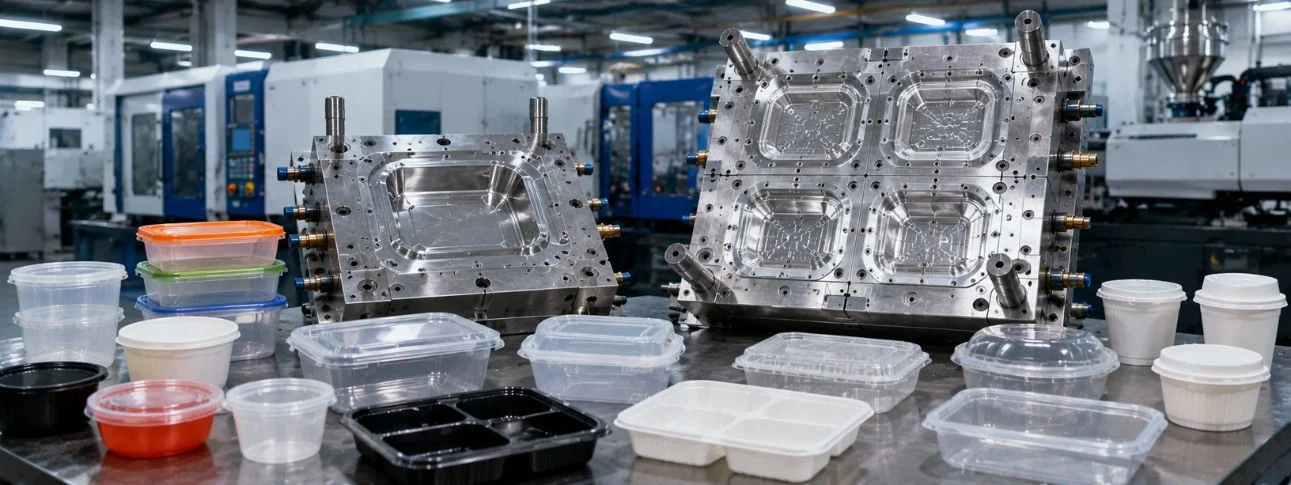
As a leading Plastic Injection Mould Manufacturer, Hitbhav Mould manufactures a full range of food containers and disposable plastic moulds, all built to your exact product drawing and production specifications.
Conclusion – your food container mould is your most important production decision
Every single food container you will ever sell starts inside a mould. The quality of that mould, the steel grade, the design, the cavity layout, and the cooling system determine the quality of every part you produce, at every price point, for the entire life of that tool.
Choose wisely, and production flows consistently, cost-per-part stays low, and your packaging stands out on the shelf. Choose carelessly, and you spend more time managing defects, re-ordering, and re-tooling than actually growing your food business.
At Hitbhav Mould, we have guided food packaging businesses through every one of these decisions. Whether you are launching your first Plastic Food Container Mould or scaling an existing line, our team is ready to give you expert advice with complete transparency.
Free Expert Consultation
Tell us your food product we will recommend the exact mould you need
Share your container drawing, a reference sample, or a description. Our engineers will tell you the right mould type, resin, steel grade, and cavity count — saving you time, cost, and mistakes from day one.