
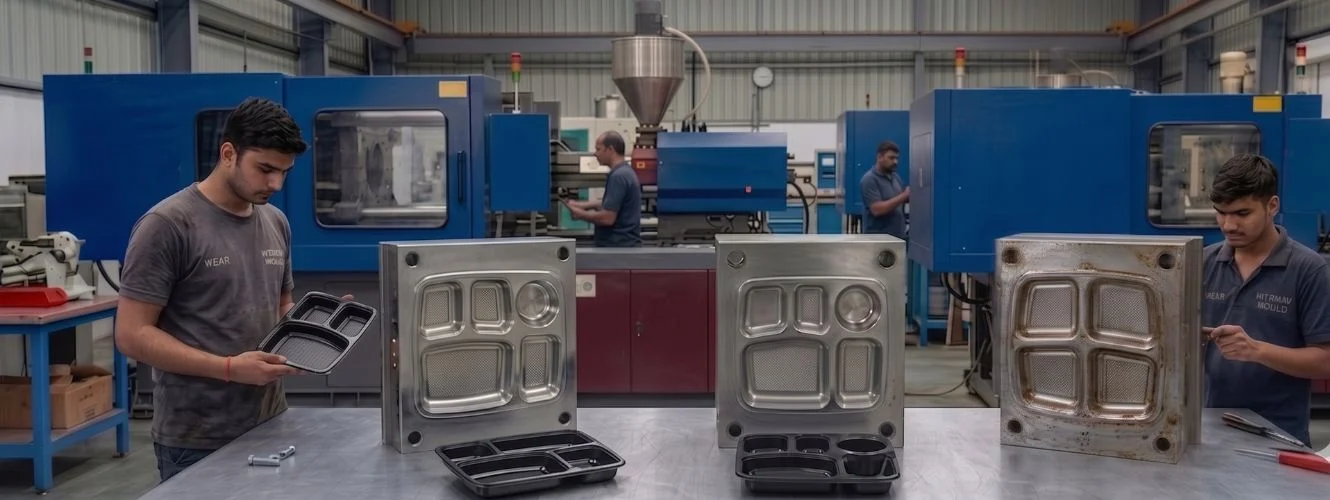
The real answer is not one number; it depends on material, maintenance, machine settings, and who made it. Here is the complete, honest guide.
You invested in a plastic injection mould. Lakhs of rupees. Weeks of lead time. Now you want to know one thing: How long will this mould actually last before I have to replace it?
It is one of the most common questions we hear at Hitbhav Mould — and also one of the most misunderstood. Some manufacturers will quote you a number like “one million shots” without explaining that this figure only holds true under very specific conditions. In reality, mould lifespan depends on the material it is made from, how it is maintained, what plastic you run through it, and the precision with which it was built in the first place.
This guide gives you the complete, honest picture from a team that has been making Plastic Injection Moulds for over years
The short answer: It depends — here is the real breakdown
A well-built plastic injection mould can last anywhere from 10,000 shots to over one million shots. The range is enormous because mould life is not a fixed property it is a result of multiple decisions made before, during, and after production.
Aluminium mould – 10K – 100K shots
Semi-steel mould – 100K – 300K shots
P20 steel mould – 300K – 500K shots
H13 hardened steel – 500K – 1M+ shots
These numbers assume correct mould design, proper machine settings, compatible plastic material, and regular maintenance. Skip any of those conditions, and the mould will wear out significantly faster.
6 factors that decide how long your mould lasts
1 – Mould material
Steel grade is the single biggest factor hardened H13 outlasts aluminium by 10x or more
2 – Plastic material used
Abrasive materials like glass-filled nylon or PVC wear cavities much faster than PP or LDPE
3 – Machine settings
Wrong injection pressure, temperature, or clamping force causes premature cracking and deformation
4 – Mould design quality
Poor gate placement, insufficient cooling channels, and thin walls shorten mould life considerably
5 – Maintenance routine
Moulds that are cleaned, lubricated, and inspected regularly last far longer than neglected ones
6 – Mould maker’s precision
Tight tolerances and proper heat treatment during manufacturing determine the baseline durability
At Hitbhav Mould, we address every one of these six factors during the design and build process. Our DFM (Design for Manufacturability) reviews catch problems before a single gram of steel is cut.
How mould material affects lifespan — explained simply
Aluminium moulds
Aluminium moulds are excellent for prototypes and small production runs. They are fast to machine and affordable. But aluminium is soft compared to steel, cavities wear, surfaces scratch, and dimensions shift over time. For a Plastic Food Container Mould trial run of 20,000 pieces, aluminium is perfectly fine. For 500,000-piece annual runs, it is not the right tool for the job.
P20 pre-hardened steel moulds
P20 is the most widely used mould steel in India. It is pre-hardened to around 30–36 HRC, machines well, and provides reliable service for medium to high-volume production. Most of our Houseware Moulds, including plastic bucket moulds, plastic tray moulds, and plastic mug moulds, are built in P20 steel. Expect 300,000 to 500,000 shots with proper care.
H13 hardened tool steel moulds
H13 is heat-treated to 48–52 HRC, making it significantly harder and more wear-resistant than P20. It is the best choice for long-running production of Industrial Plastic Moulds such as crate moulds, battery container moulds, and electrical switch box moulds, where tolerances must stay tight across hundreds of thousands of cycles. Expect 500,000 to well over one million shots.
“We always tell clients: do not choose a mould material based only on today’s order. Think about where your product will be in two years. A slightly higher investment in steel-grade now can save you the cost of retooling entirely.”
Warning signs that your mould is nearing the end of its life
Watch out for these signs in your production line
If you are seeing any of the above, it is time for a professional mould inspection. At Hitbhav Mould, we offer mould repair and refurbishment services, so you may not need to replace the entire tool. Many moulds can be salvaged with cavity welding, re-polishing, or component replacement at a fraction of replacement cost.
How to make your mould last significantly longer – 6 practical tips
Tip 01 – Clean after every production run
Remove plastic residue, rust, and debris from all surfaces. Use the correct cleaning agents, and avoid anything abrasive on polished cavities
Tip 02 – Apply rust-preventive grease during storage
Even short storage periods can cause surface oxidation. Always coat with mould-grade rust preventive before placing in storage
Tip 03 – Run the correct machine settings
Over-pressurising or running too-high melt temperatures will fatigue the steel faster. Validate settings during the T1 trial and document them
Tip 04 – Lubricate moving components regularly
Ejector pins, leader pins, and sliders need fresh lubrication every 5,000 to 10,000 shots for smooth operation and to prevent galling
Tip 05 – Schedule periodic professional inspections
Have the mould inspected every 50,000 to 100,000 shots by your mould manufacturer. Early detection of wear is far cheaper than emergency repair
Tip 06 – Match the plastic to the mould material
Always confirm with your Plastic Mould Maker that the resin you plan to run is compatible with the mould steel grade chosen
Mould lifespan by product type — what Hitbhav Mould recommends
Different products have different production demands. Here is how we approach mould-grade selection for each of our core service categories:
| Mould Category | Products | Recommended Material |
|---|---|---|
| Toy Moulds | Plastic Toy Car Mould, building blocks, and rattles | P20 or H13 steel – ideal for fine detail & precision |
| Houseware Moulds | Bucket Mould, dustbin, lunch box, storage container | P20 steel – durable, cost-effective for high-volume use |
| Disposable Moulds | IML Container Mould, meal tray, coffee cup mould | Aluminium or P20 – depends on production volume |
| Industrial Moulds | Crate Mould, toolbox parts, battery container | H13 hardened steel – best for heavy-duty, long production |
Why clients choose Hitbhav Mould for long-lasting, precision tools
Talk to a Mould Expert Today
How long will your mould last? Let us calculate it for you.
Share your product, production volume, and plastic material, and our engineers at Hitbhav Mould will tell you exactly which mould grade you need and how long it will serve you.
To summarise: choose a steel mould if you are planning mass production and need a durable, long-lasting tool with a premium finish. Choose an aluminium mould if you are testing a new design, need faster delivery, or have a limited initial budget.
Both options have a place in smart manufacturing. The best choice depends entirely on your specific situation, and the easiest first step is to talk to an expert.
Ready to get started?
📞 Contact Hitbhav Mould today for a Free Mould Consultation and Quote. Share your product drawing, sample, or idea, and we will take it from there.