
Why Choosing the Wrong Mould Material Can Cost You More Than You Think
If you’re planning to develop a new product, one of the biggest decisions is choosing the right mould material. Many businesses get confused between Steel Moulds and Aluminium Moulds.
Pick the wrong one, and you could end up spending more than needed, getting poor-quality parts, or having a mould that wears out too quickly. Choose wisely, and your production runs smoothly, costs stay controlled, and your products look sharp every time.
At Hitbhav Mould, an experienced plastic mould manufacturer, we have helped hundreds of clients from small startups to large factories make this exact decision. In this guide, we break it all down in simple language so you can choose with confidence.
What Are Plastic Injection Moulds Made Of?
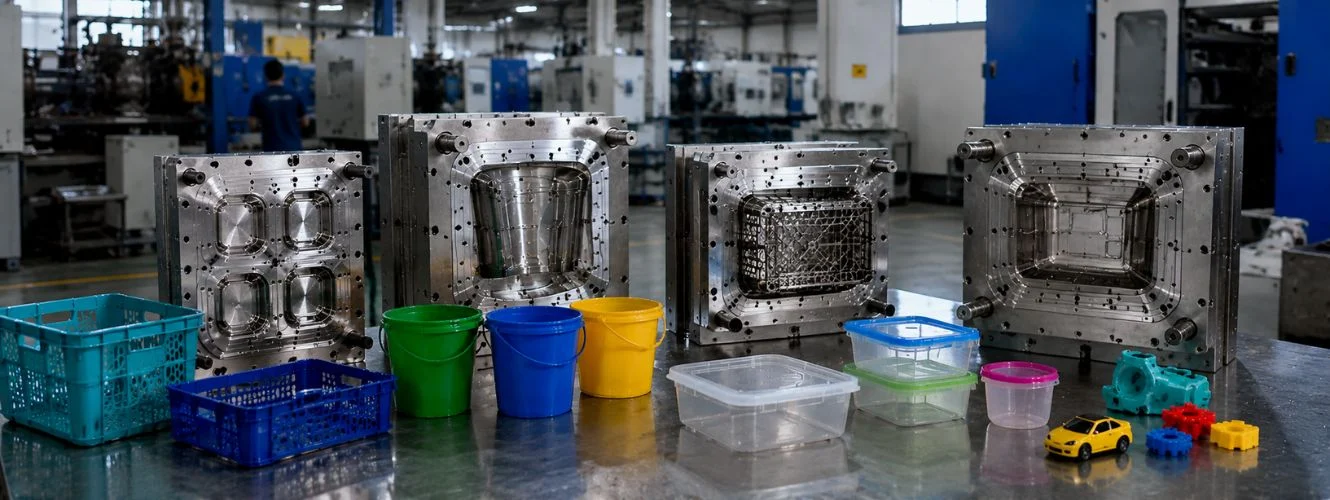
A plastic injection mould is a precision tool used in a Plastic Injection Moulding Machine. Molten plastic is injected into the mould under pressure, cooled, and ejected as a finished part, a toy, a bucket, a crate, or any other shape you need.
The two most common materials used to make these moulds are hardened tool steel and aluminium alloy. Each has its strengths, and the right choice depends on your product type, production volume, and budget.
“The mould is the heart of the manufacturing process. Getting the material right from the start saves you time, money, and rework in the long run.”
Steel Moulds — Built for the Long Run
What Is a Steel Mould?
Steel moulds are made from hardened tool steel, typically P20, H13, or 718H grades. They are manufactured using CNC machining, EDM (Electrical Discharge Machining), and precision grinding, all processes that Hitbhav Mould carries out in-house for every custom steel mould project.
When Should You Choose Steel?
Steel moulds are ideal if you are planning high-volume production, anything above 50,000 to 100,000 parts. The hardness and durability of steel mean your mould can handle millions of injection cycles without wearing out.
At Hitbhav Mould, our steel moulds are used across a wide range of products, including plastic crate moulds, plastic bucket moulds, plastic storage container moulds, and plastic electrical switch box moulds. These products are made in large quantities, and only a steel mould can handle that kind of demand without compromising on part quality.
Key Advantages of Steel Moulds
Aluminium Moulds — Fast, Light, and Smart for Prototypes
What Is an Aluminium Mould?
Aluminium moulds are made from aerospace-grade aluminium alloys such as 7075 or 6061. They are machined significantly faster than steel, which means lower tooling costs and quicker delivery, sometimes 30 to 50% faster than a comparable steel mould.
When Should You Choose Aluminium?
If you are at the product development or prototyping stage, or if you need a small-to-medium production run (1,000 to 50,000 parts), an aluminium mould makes excellent sense. It lets you test your design, fix issues, and reach the market faster, all at a lower initial investment.
For example, a startup launching a new plastic food container or a new plastic toy car may want to test the market before committing to a full steel production mould. An aluminium mould is perfect for this use case.
Key Advantages of Aluminium Moulds
Steel vs Aluminium Moulds — Side-by-Side Comparison
| Factor | Steel Mould | Aluminium Mould |
|---|---|---|
| Mould Life | 500,000 – 1 million+ shots | 10,000 – 100,000 shots |
| Upfront Cost | Higher (economic long-term) | Lower (great for prototypes) |
| Lead Time | 4 – 8 weeks typically | 1 – 3 weeks typically |
| Surface Finish | Excellent — mirror polish possible | Good — suitable for most products |
| Best For | Mass production, industrial, housewares | Prototyping, low volume, testing |
| Repairability | Easy to weld and repair | Limited once damaged |
| Cycle Time | Standard | Faster (better heat dissipation) |
| Cost Per Part | Much lower at high volumes | Higher if used for mass production |
Which Mould Is Right for Your Product?
The answer depends on three things: your production volume, your budget, and the type of product you are making. Here is a quick guide based on our experience as a custom plastic mould manufacturer:
Need mass production of plastic buckets, crates, housewares, or industrial parts?
→ Choose a steel mould (hardened P20 or H13 grade).
Need a prototype or market test batch of 5,000 to 25,000 pieces?
→ Choose an aluminium mould faster and more affordably.
Need toy moulds like building blocks, rattles, or kitchen sets for export?
→ Choose a steel mould with superior finish and dimensional accuracy.
Need a disposable container or cup mould at a competitive price?
→ Aluminium or semi-steel speak to our engineers for the right call.
Still unsure? Our team at Hitbhav Mould will review your product drawing or sample, understand your production targets, and recommend the most cost-effective solution with zero pressure to spend more than you need to.
Why Choose Hitbhav Mould?
Here’s what you get with Hitbhav Mould:When selecting a Plastic Mould Manufacturer, trust matters.
Here’s what you get with Hitbhav Mould:
When selecting a Plastic Mould Manufacturer, trust matters.
We ensure your mould performs efficiently and delivers long-term value.
Conclusion — Make the Right Mould Decision Today
To summarise: choose a steel mould if you are planning mass production and need a durable, long-lasting tool with a premium finish. Choose an aluminium mould if you are testing a new design, need faster delivery, or have a limited initial budget.
Both options have a place in smart manufacturing. The best choice depends entirely on your specific situation, and the easiest first step is to talk to an expert.
Ready to get started?
📞 Contact Hitbhav Mould today for a Free Mould Consultation and Quote. Share your product drawing, sample, or idea, and we will take it from there.