
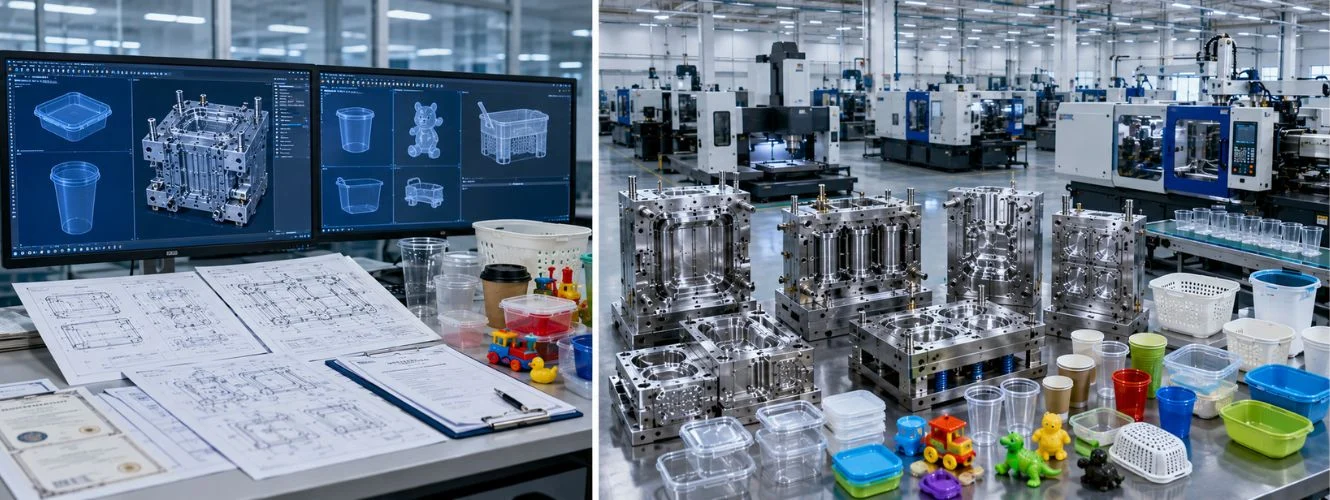
Introduction: Most Buyers Ask the Wrong Questions
Every day in India, business owners from first-time entrepreneurs to seasoned manufacturers search online for a reliable Plastic Injection Mould Manufacturer. They get dozens of quotes. They compare prices. And far too often, they make their decision based on price alone.
Then the problems start. The mould arrives late. The sample parts have sink marks, flash, or warping. The wall thickness is inconsistent. Or worse the mould fails after 50,000 shots when it was supposed to last 500,000.
The root cause is almost always the same: they asked the wrong questions before choosing their mould supplier.
At Hitbhav Mould, a trusted plastic mould manufacturer, we have seen this happen hundreds of times. So we put together this guide: the 10 most important questions you must ask any Plastic Die Maker before you hand over your order. Ask these, and you will filter out unreliable suppliers and find a partner who will genuinely support your production success.
1. What types of moulds have you made before and do you have experience in my product category?
This is the first and most important question. Plastic Injection Mould Manufacturing is not a one-size-fits-all industry. A manufacturer with strong experience in Industrial Product Mould may not have the same expertise in toy moulds or disposable cup moulds and vice versa.
Different product categories demand completely different mould design knowledge. A Plastic Toy Mould needs safe, burr-free edges and precise snap-fit assembly. A Disposable Coffee Glass Mould needs thin-wall expertise and fast cycle times. A Plastic Crate Mould needs heavy-duty steel and strong structural design.
Ask for specific examples of moulds they have made in your product category with photos, part samples, or client references.
2. What mould steel grades do you use and can you provide material certificates?
The steel inside your mould determines everything: dimensional accuracy, surface finish, mould life, and maintenance frequency. This is the most overlooked question buyers fail to ask, and it is where low-cost suppliers cut the biggest corners.
Standard grades used by reliable Plastic Injection Mould Manufacturers include:
- P20 – general-purpose, good for low to medium volume production (up to 300,000 shots)
- 718H – improved corrosion resistance, suitable for up to 500,000 shots
- H13 hardened – high-volume production, 1,000,000+ shot life, ideal for industrial plastic moulds
- S136 stainless – mirror-finish clarity for transparent parts like disposable cup moulds and food container moulds
3. Do you perform a DFM (Design for Manufacturability) review before starting machining?
A DFM review is a detailed engineering analysis of your product design before the mould is built. It checks whether your part can be injection-moulded correctly without defects, without difficult ejection, and without costly mould modifications later.
A proper DFM review for a Plastic Injection Mould covers:
- Wall thickness uniformity – prevents sink marks, warping, and short shots
- Draft angles on all vertical walls – ensures clean part release without drag marks
- Gate location – determines how plastic fills the cavity and where the gate mark appears
- Parting line placement – affects the appearance and function of the finished part
- Undercuts and side actions – identifies features that require special mould mechanisms
- Shrinkage compensation – different plastics shrink at different rates; cavities must be sized accordingly
4. What machining equipment do you have in-house or do you outsource any processes?
The quality and precision of a plastic injection mould depends directly on the machining equipment used to build it. Ask specifically what the supplier has in-house and what if anything gets outsourced.
Key equipment a serious plastic injection mould manufacturer should have:
- CNC milling centre – for high-precision cavity and core machining with tight tolerances (±0.01mm)
- Wire-cut EDM – for complex shapes, fine details, and sharp corners that CNC cannot reach
- Sink EDM (die sinking) – for deep cavities and textured surfaces
- Surface grinding machine – for flat, precision mould base components
- CMM or optical measuring tools – for dimensional inspection and quality verification
- Injection moulding machine for mould trials – to run T1 samples in-house before delivery
- What does your mould trial process look like and what documentation do I receive?
Before any mould leaves the factory, it must be trialled on a Plastic Injection Moulding Machine and the results must be documented. This is called the T1 trial first-off sample production and it is the only way to confirm the mould actually works as designed.
Ask your Plastic Die Maker exactly what the T1 trial covers and what report you will receive. A professional T1 report should include:
- Dimensional measurements against your drawing – at multiple points on each part
- Part weight – confirms consistent material fill per shot
- Surface finish assessment – visual check for sink marks, flash, weld lines, drag marks
- Functional test – fit check, snap-fit test, stack test (for cups), or assembly test (for toys)
- Cycle time confirmation – to verify your production output target is achievable
- Photos of the T1 samples with date and measurement annotations
5. What exactly is included in the mould price and what costs extra?
Price transparency is one of the biggest issues when sourcing a custom plastic mould in India. Many suppliers quote a low base price and then add charges for mould design, DFM review, T1 trials, mould modifications, surface treatment, hot runner systems, or shipping leaving buyers with a final cost far higher than expected.
Always ask specifically what the quoted price includes:
- Is mould design (3D CAD) included?
- Is DFM review included?
- How many T1 trial shots are included?
- Are mould modifications after T1 included or charged separately?
- Is the hot runner system (if applicable) included?
- Is surface treatment (nitriding, chrome, texture) included?
- What does mould packaging and shipping cost?
6. How do you control quality during the mould manufacturing process?
Quality in plastic injection mould manufacturing is not a single checkpoint at the end, it is a continuous process built into every stage of mould making. Ask your potential supplier how quality is monitored throughout production, not just at final inspection.
A well-run mould manufacturer should have quality controls at every stage:
- Design stage: DFM review, mould flow simulation (for complex parts), 3D design approval
- Steel procurement: material certificates, incoming inspection of steel hardness and dimensions
- Machining stage: in-process CMM or optical measurement checks after CNC and EDM operations
- Assembly stage: fitting inspection parting line quality, ejector pin travel, cooling circuit pressure test
- Trial stage: documented T1 sample report with dimensional and visual results
7. What is your delivery timeline and how do you keep me updated during production?
Delivery delays in mould manufacturing are common and they are expensive. If your mould is late, your entire production launch is delayed, your customers are unhappy, and your investment sits idle. Always ask for a clear, milestone-based timeline before you confirm the order.
A professional plastic injection mould manufacturer should provide:
- A written timeline with milestones – design approval, steel procurement, machining complete, assembly, T1 trial, delivery
- Regular progress updates – photos of machining progress, assembly, and trial shots
- A clear escalation process if a delay is anticipated
- An honest assessment of lead time – not an unrealistic promise made to win the order
8. What after-sales support and mould warranty do you offer?
Your relationship with a mould manufacturer does not end when the mould is delivered, it is just beginning. Over the life of the mould, you will need technical support, spare parts, maintenance guidance, and occasional mould repairs. The quality of after-sales support is what separates a true manufacturing partner from a one-time transaction supplier.
Always ask these specific questions about after-sales:
- What is the mould warranty, how many shots, or how many months?
- What defects are covered under warranty and what are excluded?
- Do you provide complete mould documentation 2D assembly drawing, 3D files, BOM (bill of materials)?
- Do you stock spare mould components (ejector pins, springs, hot runner tips)?
- What is your typical response time if I have a production issue?
- Can you service the mould if it needs repair or modification in the future?
10. Can I see samples of your work or speak directly with your existing clients?
This is the trust question and it is the most powerful filter of all. Any Plastic Injection Mould Manufacturer worth working with should be able to show you physical part samples, project photos, or client testimonials without hesitation.
What to ask for specifically:
- Sample parts produced from moulds they have made – not just photos, but actual physical samples if possible
- Photos of the mould workshop, machining in progress, and T1 trial shots
- Client references – at least 2–3 existing clients in a similar product category who you can contact directly
- Case studies – what was the challenge, what mould was designed, and what was the outcome?
Conclusion: The Right Questions Lead to the Right Manufacturer
Choosing the right Plastic Injection Mould Manufacturer in India is one of the most important decisions you will make for your business.
Use these 10 questions as your filter. Any mould manufacturer who cannot answer them clearly and confidently is not ready to be your long-term manufacturing partner.
At Hitbhav Mould – Trusted Plastic Mould Manufacturer we welcome every one of these questions
Ready to ask us all 10? We are ready to answer.