
Plastic IML Container Mould: How It Works and When to Use It
On this page
Short answer: IML stands for in-mould labelling. A printed label is placed inside the open mould, plastic is injected over it, and the label becomes part of the container. You get sharp, long-lasting printing with no sticker to peel. The trade-off is a higher mould and setup cost, so it suits steady, high-volume products.
Walk down any ice cream or dairy aisle and look at the tubs. Many of them have bright, glossy printing that never peels, bubbles or fades, even in a freezer. Chances are, that is IML.
If you are planning to make containers and wondering whether IML is for you, this guide explains how it works, what the mould needs, the good and the not-so-good, and how to decide.
What is IML, in simple words?
Normal printed containers are made in two steps. First the container is moulded. Then a sticker is stuck on it, or the print is applied on the outside.
With IML, there is only one step. The label goes into the mould before the plastic does. When hot plastic is injected, it fuses with the label. The container comes out of the mould already decorated. The artwork is part of the wall, not something sitting on top.
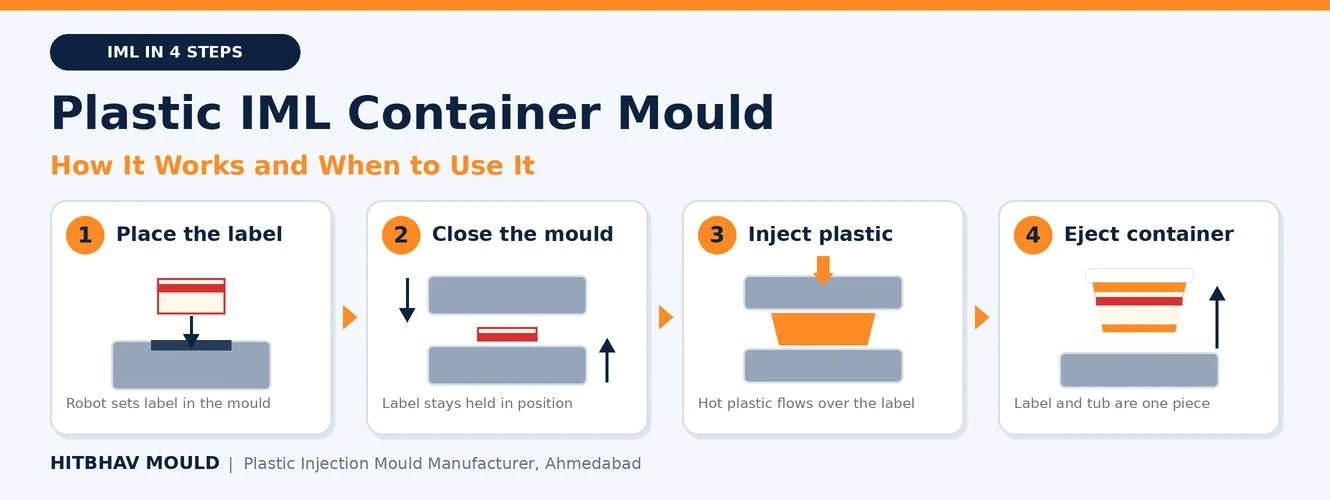
How the IML process works
- The mould opens. After the last container is ejected, the two halves of the mould separate.
- A robot places the label. A robot arm picks a printed label and puts it exactly in position inside the mould cavity. The label is held there, often with static charge or vacuum, so it doesn’t move.
- The mould closes. It closes with the label sitting in place.
- Plastic is injected. Molten plastic flows into the cavity and over the label.
- Cooling and fusing. The label and the container bond as the plastic cools. Good cooling matters a lot here because cycle times are short.
- The container is ejected. The finished, decorated container comes out. The robot removes it and the cycle repeats.
This all happens in seconds, and it runs again and again. That is why IML lines are fast but need careful setup.
What an IML container mould needs
An IML mould is not just a normal thin-wall mould with a label dropped in. A few things make it special:
- Label holding features: the cavity must hold the label flat and steady until the plastic arrives.
- Accurate alignment: if the label sits even slightly off, the artwork looks crooked on every container.
- Strong cooling: fast, even cooling gives you short cycles and a clean bond between label and plastic.
- Thin-wall build: IML containers usually have thin walls, so the steel and the hot runner system must handle high pressure and speed.
- Robot-friendly design: the mould must open wide enough and be shaped so the robot can place labels and remove containers without a clash.
These details are why IML moulds need careful design and trial before they go into production. At Hitbhav Mould, every design is validated before steel is machined, and you can see our plastic IML container mould page for what we build.
The good side of IML
- Eye-catching printing. Sharp colours, photos and fine detail, all over the container.
- The print stays. It resists moisture, scratches and fading, so it works well for freezers and fridges.
- No separate labelling step. No stickers to apply and no print to dry after moulding.
- Hygienic surface. The label is fused to the wall, so there is no edge to lift or trap dirt.
- Brand impact. Containers look premium on a shelf.
The not-so-good side
- Higher upfront cost. The mould is more complex, and you also need label-placing automation.
- Label cost on every piece. IML labels are printed on special film and add to your per-container cost.
- Less flexibility. Changing artwork means printing new labels, and large label stocks can go to waste if your design changes.
- Needs a good setup. Machine, mould, robot and labels must all work together. A small mismatch causes rejects.
Rough guide: IML moulds usually sit at the higher end of food container mould prices, often ₹25 lakh and above, and the label automation is separate. This is not a quote. Our guide on plastic food container mould cost in India explains what moves the price.
When IML makes sense
| IML is a good fit when… | Think twice when… |
|---|---|
| You make large, steady volumes every month | Your volume is small or uncertain |
| Your branding and shelf look matter a lot | Your artwork changes often |
| Your product is stored cold or in humid places (ice cream, dairy, spreads) | Your budget for mould and automation is tight |
| You want a durable, peel-free print | A simple sticker or direct print does the job |
Typical IML products include ice cream tubs, dairy and curd containers, spreads, pickle jars and other branded food packs. For ice cream in particular, see our plastic ice cream cup mould page.
Plastic and food safety for IML containers
Polypropylene is the usual material for IML containers, with a matching PP-based label. When the label and the container are the same type of plastic, they fuse well. For food use, both the resin and the label must be suitable for food contact, and the finished container should be tested. We cover this in our guide on food-grade plastic moulds in India.
How many cavities should an IML mould have?
It depends on your demand and your machine. More cavities give more output per cycle, but the robot also has to place more labels each time, so the automation gets more complex. Our comparison of single cavity vs multi-cavity moulds will help you work out a sensible number.
Questions to ask before you choose IML
- How many containers will I make each month? Is that steady?
- Is my design stable, or will the artwork change often?
- Does my injection machine suit fast, thin-wall moulding?
- Who supplies and designs the label film, and who supplies the robot?
- What is included in the mould quote, and what is separate?
- Can the mould maker do a trial with labels, and share samples to approve?
If you are making simple disposable items and IML feels like too much, read our overview of plastic injection moulds for disposable products to see the other options.
Thinking about an IML container?
Tell us your container size, plastic and monthly volume. We offer 3D design support and DFM analysis, so you can start with a sample or an idea.
Request a quote or call +91 99258 10161. You can also write to info@hitbhavmould.com.
Frequently asked questions
1. What does IML mean in plastic containers?
IML means in-mould labelling. A printed label is placed inside the open mould, and the plastic is injected over it. The label and the container fuse into one piece, so the print becomes part of the container.
2. Is an IML container mould more expensive than a normal one?
Usually yes. The mould needs extra features to hold the label in place, and you also need robot automation to place labels. The label itself adds a running cost on every container.
3. Which plastic is used for IML containers?
Polypropylene (PP) is the most common, along with a matching PP-based label. When the label and the container are the same type of plastic, they fuse well and are easier to recycle together.
4. When is IML worth it?
IML is worth it when you make large, steady volumes and want strong, good-looking printing that will not peel or fade. Typical uses are ice cream, dairy, spreads and other branded food tubs.
5. When should I not choose IML?
If your volume is small, your artwork changes often or your budget is tight, simpler options such as stickers or direct printing can be a better fit.
6. Can I use my existing injection machine for IML?
Only if it is suited to fast, thin-wall moulding and can work with a label-placing robot. Share your machine details with your mould maker before the design starts so the mould and automation match.
So, is IML right for you?
IML gives you a premium, durable look, but it asks for more money and more planning at the start. If your volumes are steady and your brand needs to stand out, it can pay off well. If you are just starting out, many businesses begin with a simpler container and move to IML as they grow.
We are Hitbhav Mould, a plastic injection mould manufacturer in Kathwada GIDC, Ahmedabad, working with customers across India and abroad.
About the author: Written by the Hitbhav Mould team, based on our mould design and manufacturing work in Ahmedabad using CNC and EDM machining, Moldflow-based design validation and strict quality checks.
Planning a mould?
Send your drawing, sample or photos. Every mould is made to order and trialled before dispatch.

We design and make plastic injection moulds in Kathwada GIDC, Ahmedabad: 8+ years in business, steel moulds (P20, H13, EN31, S136), every mould trialled before dispatch. About us · Our process
Related guides

Food-Grade Plastic Moulds in India: Material and Safety Basics
Short answer: "food-grade" mostly describes the plastic and the finished container, not the steel mould. A good food-grade mould is one that is built, finished and…
How Much Does a Plastic Food Container Mould Cost in India?
Short answer: a plastic food container mould in India usually costs between ₹1 lakh and ₹25 lakh, sometimes more. A simple single-cavity mould sits at the…
Plastic Injection Mould Cost in India: What Decides the Price
Short answer: a plastic injection mould in India costs anywhere from about ₹1 lakh for a small, simple mould to ₹10 lakh or more for a…