
Introduction
When investing in a new plastic injection mould, one of the most important decisions is choosing between a Single Cavity Mould and a Multi-Cavity Mould.
Many business owners focus only on the initial mould cost. However, the right mould choice affects your production speed, manufacturing cost, product quality, machine efficiency, and long-term profitability.
Whether you manufacture food containers, disposable cups, houseware products, plastic toys, or industrial components, partnering with an experienced Plastic Injection Mould Manufacturer can help you select the best mould solution for your production requirements.
In this guide, we explain both mould types so manufacturers, business owners, and production managers can choose the best solution for their production requirements.
What Is a Single Cavity Mould?
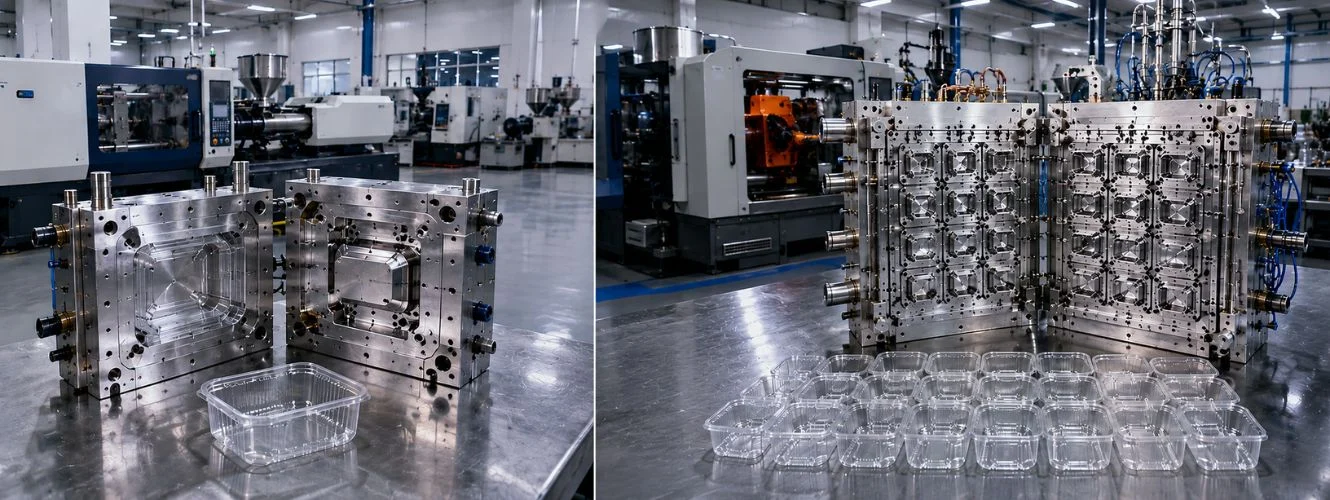
A Single Cavity Mould produces one plastic part during each injection moulding cycle.
Simply put:
For example, if you manufacture a plastic food container using a single cavity mould, each machine cycle produces only one container.
Advantages of Single Cavity Moulds
What Is a Multi-Cavity Mould?
A Multi-Cavity Mould contains multiple cavities that produce several identical parts in a single injection cycle.
Examples:
This design significantly increases production efficiency.
A professional Plastic Injection Mould Manufacturer can design multi-cavity moulds based on your production targets and machine capacity.
Advantages of Multi-Cavity Moulds
Single Cavity vs Multi-Cavity Mould: Quick Comparison
| Feature | Single Cavity Mould | Multi-Cavity Mould |
| Production Output | Low | High |
| Initial Cost | Lower | Higher |
| Cost Per Product | Higher | Lower |
| Maintenance | Easier | More Complex |
| Development Time | Faster | Longer |
| Suitable For | Small Production Runs | Large Production Runs |
| ROI Potential | Moderate | High |
Which Mould Is Best for Your Production Volume?
Low Production Volume
If your annual production requirement is below 50,000 units, a single cavity mould may be the most cost-effective option.
Suitable for:
Medium to High Production Volume
If your production requirement exceeds 100,000 units annually, a multi-cavity mould usually provides better long-term value.
Suitable for:
A trusted Plastic Mould Maker can help calculate your production costs and determine the most profitable mould configuration.
What About Mould Cost?
Many buyers ask:
“Why is a multi-cavity mould more expensive?” The answer is simple.
A multi-cavity mould requires:
However, the increased production capacity usually delivers a faster return on investment.
An experienced Plastic Mould Manufacturer can help calculate the payback period based on your expected production volume.
Why Precision Matters in Multi-Cavity Moulds
Not all mould manufacturers can successfully build high-performance multi-cavity moulds.
Every cavity must produce identical parts.
Even a small dimensional difference can cause:
This is why businesses should work with a Trusted Plastic Injection Mould Manufacturer that uses:
Best Mould Steel for Long Production Runs
Production volume also affects mould steel selection.
Common options include:
P20 Steel
H13 Steel
S136 Steel
NAK80 Steel
A professional mould manufacturer can recommend the best steel based on your production goals.
Questions to Ask Before Choosing a Mould
Before ordering a mould, ask:
These answers help determine whether a single cavity or multi-cavity mould is the better investment.
Why Choose Hitbhav Mould?
At Hitbhav Mould, we specialize in designing and manufacturing high-performance moulds for:
As a trusted Plastic Injection Mould Manufacturer, we help businesses select the most cost-effective mould solution based on production volume, product design, and long-term growth plans.
Conclusion
Choosing between a single cavity mould and a multi-cavity mould is not simply about tooling cost, it is about production efficiency, long-term profitability, and business growth.
Working with an experienced Plastic Injection Mould Manufacturer ensures you receive the right mould solution for your production goals.
Ready to Find the Right Mould for Your Production Volume?
Hitbhav Mould provides custom mould solutions designed to maximize efficiency and profitability.