
Every mould we build starts as a design on screen. Before any steel is cut, we check your part for moulding problems (a DFM review, free with every quote), design the complete mould in 3D CAD, simulate how the plastic fills it with Moldflow, and send you the design to approve. A problem found at this stage costs minutes to fix. The same problem found in hardened steel costs days and money.
You can start with a finished 3D file, a 2D drawing, a sample of an existing product, or only an idea with its main sizes. Since 2018, Hitbhav Mould has designed and built more than 500 moulds in Ahmedabad for disposable, houseware, industrial and toy products.
What you can send us
- A 3D CAD file of the part
- A 2D drawing with dimensions
- A sample of an existing part
- Photos with the main sizes, or a sketch of your idea
Also tell us the plastic material, how many parts you plan to make in a year, the number of cavities you have in mind (if you know it) and the injection moulding machine you will use.
What you get from us
- Free DFM feedback: the changes we suggest to your part, and why
- A proposal for the mould: cavities, construction, runner system and steel
- A quote with the price and the delivery time
- The 3D mould design, checked with Moldflow, for your approval before machining starts
What our DFM review checks
DFM (design for manufacturability) means checking that your part can be moulded well, at the cycle time and cost you expect. We go through the part and mark anything that would cause defects, slow the cycle or make the mould more complex than it needs to be.
| What we check | Why it matters |
|---|---|
| Wall thickness | Even walls cool evenly. Thick spots cause sink marks, voids, warpage and longer cycles. |
| Draft angles | A slight taper in the direction the mould opens lets the part release without scratches or ejector marks. |
| Ribs and bosses | Too thick and they leave sink marks on the other face; too thin or tall and they are hard to fill and eject. |
| Undercuts, side holes and threads | Each one needs a slide, lifter or unscrewing core, which adds cost. A small change to the part can often remove it. |
| Gate position | Where the plastic enters decides the gate mark, where weld lines form and how evenly the part fills. |
| Parting line | Where the two mould halves meet. It leaves a fine line on the part and affects flash. |
| Shrinkage | Every plastic shrinks as it cools, by a different amount. The cavity is made larger to suit, so the part ends up at the right size. |
| Corners and radii | Sharp inside corners weaken the part and slow the flow of plastic. |
| Critical sizes | We agree which dimensions really matter, so the mould is made to hold them. |
| Ejection | Where the pins or plates push, so the part comes off flat and without marks. |
Want to check your own drawing first? Our plastic part design guidelines list the ten points we look at most often.
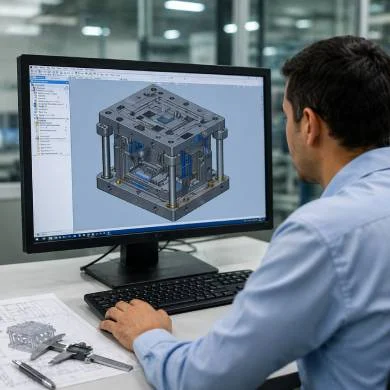
How we design the mould
Once the part is right, we design the mould around it:
- Cavities and layout: one cavity or several, based on your yearly volume and machine size. See single cavity vs multi-cavity moulds.
- Construction: a two-plate or three-plate mould, with a cold runner or a hot runner.
- Gate: the type, size and position of the gate. See injection mould gate types.
- Cooling: water channels placed to cool the part evenly. Cooling sets most of the cycle time and stops warpage.
- Ejection: pins, sleeves or a stripper plate, so the part comes off cleanly.
- Steel: P20, H13, EN31 or S136, chosen for your plastic, finish and volume. See mould steel compared.
- Machine fit: mould size, shot weight and clamping force checked against your injection moulding machine.
Moldflow simulation before steel is cut
Moldflow is simulation software that shows how molten plastic will fill the mould. We use it to check:
- that every part of the cavity fills, with no short shots;
- where weld lines and trapped air will form;
- how much injection pressure the part needs;
- how evenly the part cools, and where it may warp.
If the simulation shows a problem, we move the gate, change the runner or the cooling, or suggest a change to the part, and run it again. That is far quicker and cheaper than changing the steel after the first trial. Many of the moulding defects buyers worry about can be seen here first.
From your drawing to an approved mould
- Send your part. A drawing, a sample, or photos with sizes, plus the plastic, volume and machine.
- Free DFM review and quote. We suggest changes to the part, the cavity layout, the steel and the runner system, and send you a quote with the delivery time.
- 3D mould design. We design the full mould in 3D CAD and check it with Moldflow.
- Your approval. You approve the design before we cut steel.
- Manufacturing. Machining on our own CNC and EDM machines, then assembly and polishing.
- Trial. We run the mould on an injection moulding machine and send you videos and photos of the trial and the moulded parts before dispatch.
Delivery is usually about 25 days, depending on the mould; bigger moulds take longer, and the date is agreed in your quote. See our full mould making process.
Design points for each type of mould we build
Disposable moulds
Thin walls and fast cycles. The design focuses on flow length, gate position, venting and cooling, and often a hot runner for multi-cavity moulds.
Houseware moulds
Buckets, dustbins and containers have deep cores. Even cooling keeps them straight, and lids and handles must fit every time.
Industrial moulds
Crates, battery containers and switch boxes need strong ribs, bosses for screws and sizes that hold for assembly.
Toy moulds
Small, detailed parts that must fit together, often in many cavities, with a clean finish and smooth edges.
Frequently asked questions
Send your part for a free design review
Send your drawing, sample photos or idea on WhatsApp (+91 99258 10161), email info@hitbhavmould.com, or use the form below. We reply Monday to Saturday, 10:00 to 19:00 IST.