
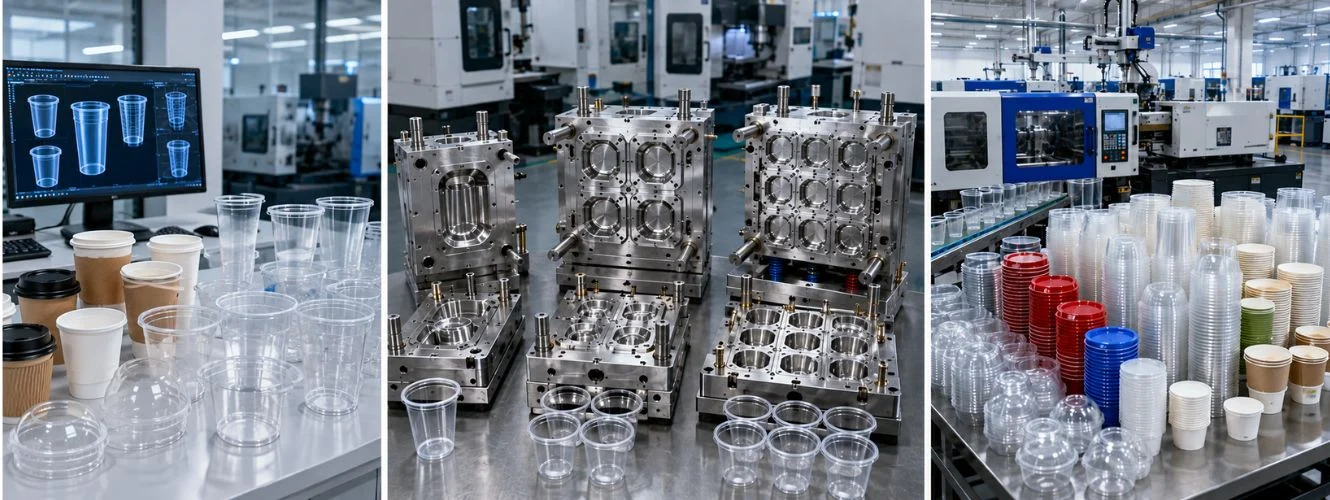
Introduction: The One Decision That Can Make or Break Your Cup Business
Every year, thousands of entrepreneurs and business owners in India enter the disposable cup and glass market cafes, food delivery startups, juice bars, catering companies, institutional suppliers, and packaging exporters. It is a fast-growing industry with strong demand and good profit margins.
But here is what most new buyers do not know: the biggest factor that determines your product quality, production cost, and profit margin is not your machine or your raw material, it is the mould you use.
A poorly designed Plastic Glass Mould leads to cups that leak, warp, have flash on the rim, or simply do not look good enough to sell. A well-designed plastic cup mould gives you consistent quality, fast cycle times, and low rejection rates run after run.
At Hitbhav Mould, we have helped hundreds of disposable cup businesses from first-time buyers to large-scale manufacturers choose and build the right Plastic Injection Mould for their specific needs. This guide explains exactly what to look for, step by step, in plain language.
Step 1 – Know Your Product First: What Type of Cup Are You Making?
Before you speak to any mould manufacturer, you need to be clear about your product. The type of cup you are making determines the entire mould design material, wall thickness, gate type, cooling, and surface finish.
Hot Coffee Cup
Needs PP material. Wall thickness 0.7–1.0mm. Heat resistant up to 130°C. Matte or semi-gloss finish.
Cold Drink Glass
PS or PET material. Crystal-clear finish. Wall thickness 0.5–0.8mm. Mirror-polish mould cavity.
Ice Cream Cup
PP or PS material. Wide mouth, thick base. Suitable for plastic ice cream cup mould.
Branded/IML Cup
PET preferred. Full-colour in-mould label. Premium look for cafes and export brands.
Step 2 – Understand Mould Cavity Count: Single vs Multi-Cavity
One of the most important and most misunderstood decisions in Plastic Cup Mould buying is the number of cavities in the mould. This directly affects your production output, your mould cost, and your machine requirement.
Single-Cavity Mould
✓Lower upfront mould cost
✓Best for product trials and startups
✓Easier to maintain and repair
✗Lower output per hour
✗Higher cost per cup
Multi-Cavity Mould (4/8/16)
✓4x–16x more cups per cycle
✓Much lower cost per cup
✓Best for high-volume production
✗Higher upfront tooling cost
✗Needs larger injection moulding machine
Practical advice: If you are starting your disposable cup business for the first time, start with a single or 2-cavity mould to validate your cup design and sales. Once you have confirmed the market, upgrade to a 4-cavity or 8-cavity Plastic Glass Mould for high-volume production. This is the approach we recommend to all first-time buyers at Hitbhav Mould.
Step 3 – Choose the Right Plastic Material for Your Cup Mould
The plastic material your Disposable Cup Mould is designed for must match your product requirement exactly. The three main materials used in plastic glass mould manufacturing are PP, PS, and PET. Each has its own strengths.
- PP (Polypropylene) – Best for hot coffee cups. Heat-resistant up to 130°C, BPA-free, food-safe, low cost, and widely recyclable. The most popular material for Disposable Coffee Cup Moulds in India.
- PS (Polystyrene) – Best for cold drink glasses. Crystal-clear, lowest material cost, rigid feel. Not suitable for hot liquids. Ideal for juice cups, cold coffee glasses, and smoothie cups.
- PET – Best for premium branded cups. Glass-like clarity, BPA-free, highly recyclable (resin code #1). Slightly higher material and tooling cost but the premium appearance justifies it for export and branded cafe chains.
Want a full deep-dive comparison? Read our blog:
PP vs PS vs PET – Which Plastic Is Best for Disposable Coffee Glass Moulds?
Step 4 – Check the Mould Steel Quality: This Is Where Most Buyers Go Wrong
This is the most overlooked factor when buying a plastic glass mould and the one that causes the most problems later. The steel used in your mould determines how long it lasts, how consistent the parts are, and how much maintenance you will need over time.
Many low-cost mould suppliers use substandard steel grades or insufficient hardness treatment.
Recommended mould steel grades for disposable cup moulds
- P20 steel – Good for low to medium volume production (up to 300,000 shots). Suitable for PP and PS cup moulds. Standard choice for startup and mid-scale operations.
- 718H steel – Improved corrosion resistance over standard P20. Good for PP and PS with longer production life up to 500,000 shots.
- H13 hardened steel – Best for high-volume production and PET cup moulds. Mould life over 1,000,000 shots. Recommended for large-scale disposable cup businesses.
- S136 stainless steel – Excellent for corrosive materials and mirror-finish requirements. Best for transparent PET and PS cups where clarity is critical.
Step 5 – Understand the Mould Trial and T1 Sample Process
Before a mould is delivered to you, it must be trialled on a Plastic Injection Moulding Machine and first-off sample cups must be produced and measured. This is called the T1 trial and it is non-negotiable for any serious plastic glass mould purchase.
During the T1 trial, your Custom Plastic Mould Manufacturer should document:
- Cup dimensions – rim diameter, base diameter, height, wall thickness at multiple points
- Cup weight – consistent weight per shot confirms stable material fill
- Visual inspection – surface finish, gate mark quality, any flash or sink marks
- Stack test – cups must stack and unstack cleanly for packaging
- Leak test – especially for coffee cups and liquid containers
- Cycle time – to confirm production output matches your requirement
Always ask for a T1 sample report with photos and measurement data before you approve the mould for shipment. A trustworthy Plastic Injection Mould Manufacturer will provide this as a standard deliverable.
Why Buyers Choose Hitbhav Mould
- In-house CNC machining and EDM – no outsourcing, full quality control under one roof
- Free DFM review – we review your design before we start, saving you time and rework costs
- Certified mould steel – every mould comes with material certificates for full transparency
- Dedicated after-sales support – our team is available for technical queries and mould servicing
Conclusion: The Right Mould Is the Foundation of a Successful Cup Business
Choose the right material. Choose the right cavity count for your production volume. Demand proper mould steel, a thorough DFM review, a documented T1 trial, and reliable after-sales support.
At Hitbhav Mould – Trusted plastic injection mould manufacturer we are here to guide you through every one of these steps. From your first enquiry to your first production run and beyond, our team is with you.