
How Much Does a Plastic Food Container Mould Cost in India?
On this page
Short answer: a plastic food container mould in India usually costs between ₹1 lakh and ₹25 lakh, sometimes more. A simple single-cavity mould sits at the lower end. A multi-cavity, thin-wall or IML mould sits at the higher end. The lid mould is almost always extra.
Food containers look simple. A tub, a lid, done. So when the first quote arrives, many new business owners are surprised by the number, and then more surprised when a second supplier quotes something completely different.
There are good reasons for that gap. This page explains what you are paying for, what changes the price, and what to ask before you say yes to any quote.
What a food container mould price includes
You are paying for the steel tool that shapes your container, plus the design work and machining behind it. The price normally covers 3D design, mould steel, CNC and EDM machining, cooling channels, polishing, fitting and a trial where the mould makes its first sample pieces.
It does not include plastic granules, machine time or labour. Those start once you begin production. If you want to see how the tool is built from start to finish, we have a separate article on how plastic food container moulds are made.
Rough price ranges in India
We can’t give an exact number without seeing your container, but this table gives you a fair starting idea.
| Type of food container mould | Rough range |
|---|---|
| Simple single-cavity container (for example a small or medium tub) | ₹1 lakh to ₹8 lakh |
| Lid mould for the same container | Usually priced separately, often a few lakh |
| Multi-cavity thin-wall container mould (2 to 4 cavities) | ₹10 lakh to ₹25 lakh |
| High-cavity or IML container mould | ₹25 lakh and above |
These are rough market ranges, not a quotation. The real price depends on container size, wall thickness, cavities, steel and finish. Treat the table as a way to check whether a quote is in a sensible zone.
Why the container and the lid cost separately
This catches a lot of first-time buyers out. A container and its lid are two different parts, so they need two different moulds. If a supplier gives you one price, ask: “Is this for the container only, or the container and the lid?”
The lid can be tricky too. A tight, snap-on or airtight lid needs accurate fitting, and that takes extra design and trial time. A lid that doesn’t fit well is the first thing your customers will complain about.
What pushes the price up or down
Wall thickness
Thin-wall containers save plastic, which is great for your running cost. But they need high injection pressure and very fast cycles, so the mould has to be stronger and the design more careful. That is why thin-wall moulds cost more than thick-wall ones.
Number of cavities
More cavities means more containers in every shot. The mould costs more, but not in a straight line. A 4-cavity mould is not four times the price of a single-cavity mould. If you want to work out the right number for your demand, read our comparison of single cavity vs multi-cavity moulds.
Size and shape of the container
A 1-litre container needs a bigger mould than a 250 ml cup. Round shapes are easier to machine than rectangles with sharp corners, ribs or logos.
Hot runner system
Most multi-cavity thin-wall moulds use a hot runner so there is less waste and cycles stay fast. It raises the upfront cost, but for high volumes it usually pays for itself.
Steel quality
Food container moulds run a lot of cycles, often millions of shots. Better steel costs more but keeps its finish and size for much longer.
Cooling design
Cooling is where thin-wall moulds are won or lost. Good cooling channels shorten the cycle, which means more containers per hour from the same machine. You rarely notice good cooling. You notice bad cooling very quickly.
Surface finish and details
A plain finish costs less. Mirror polish, embossed logos or texture all add hand work and time.
IML (in-mould labelling)
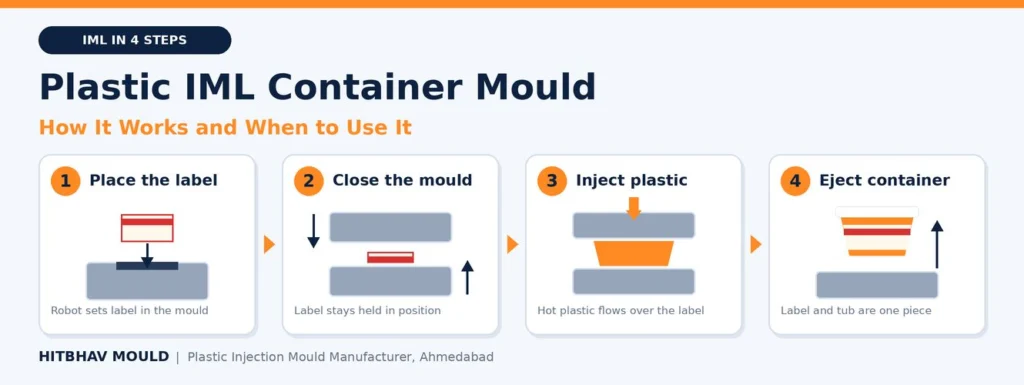
With IML, a printed label is placed inside the mould and fuses with the container as it is made, so the artwork becomes part of the product. The mould needs extra features to hold the label, and you also need robot automation to place labels. Check what is included in the quote and what is separate. If you are thinking about IML, see our plastic IML container mould page.
Think in cost per container, not just mould price
A small example. Say the container mould costs ₹10 lakh and the lid mould costs ₹4 lakh. That is ₹14 lakh in total. If you make 20 lakh sets (container plus lid), the tooling adds about ₹0.70 to each set.
Now compare a cheaper mould that saves you ₹2 lakh but runs slower and wears out earlier. Slow cycles cost you in every single hour of production. That ₹2 lakh is gone very quickly.
So before you decide, ask three things. How many containers will I sell in the first year? How fast can this mould run? How long will it last before it needs serious repair?
What to ask before accepting a quote
- Does the price cover the container only, or the container and the lid?
- How many cavities, and what steel is used?
- Hot runner or cold runner?
- Which injection machine size will it run on?
- Is there a trial, and do I get samples to approve?
- What is the delivery time?
- Is GST, transport and packing included?
- Who helps if the mould needs repair or re-polishing later?
Also confirm the plastic. Food containers are commonly made in polypropylene (PP), and it must be food-grade. Ask your resin supplier for the food-contact documents, and keep them on file. If you are still deciding how to choose a mould for your business, our guide on how to choose the right food container mould will help.
Ways to keep the cost sensible
- Keep the shape simple. Every extra rib, logo or corner adds machining time.
- Choose cavities to match demand. Buy for the next year or two, not for a dream volume.
- Fix the lid design early. Changing it later means changing steel.
- Share complete details at the start. Send a sample or drawing, the container size, expected monthly quantity and your machine tonnage. We can then quote properly the first time.
- Get the design checked before steel is cut. Fixing a problem on screen costs almost nothing. Fixing it on hardened steel costs a lot.
For a wider look at what decides mould prices across all products, read our guide on plastic injection mould cost in India.
Why the cheapest quote can hurt later
If one quote is far below the others, something is usually missing. It might be lower-grade steel, weak cooling, no proper design check, or no lid in the price. Rejected pieces, slow cycles and repairs often cost more than whatever you saved on day one.
Want a price for your container?
Send us your sample, drawing or just an idea. We give 3D design support and DFM analysis, so you don’t need a finished drawing to start. You can also see what we build on our plastic food container mould page.
Request a quote or call +91 99258 10161. You can also write to info@hitbhavmould.com.
Frequently asked questions
1. What is the price of a plastic food container mould in India?
A simple single-cavity food container mould can start around ₹3 lakh to ₹8 lakh. Multi-cavity thin-wall moulds usually cost ₹10 lakh to ₹25 lakh, and high-cavity or IML moulds can go above that. The lid mould is normally a separate cost.
2. Is the lid mould included in the container mould price?
Usually not. A container and its lid are two different parts, so they need two different moulds. Always ask whether the quote covers the container only or the container and the lid.
3. Why are thin-wall food container moulds more expensive?
Thin walls need high injection pressure, fast cycles and very good cooling. That calls for stronger steel, careful design and often a hot runner system, all of which add to the mould cost.
4. Does an IML container mould cost more?
Yes, usually. The mould needs extra features to hold the label in place, and you also need robot automation to place labels. Ask the supplier what is part of the mould price and what is separate.
5. Which plastic is used for food containers?
Polypropylene (PP) is the most common choice for food containers because it handles heat and is light. Always use food-grade material and ask your resin supplier for the relevant food-contact documents.
6. How can I reduce my food container mould cost?
Keep the shape simple, choose a sensible number of cavities for your demand, decide on the lid design early and avoid extra features that need complex mould parts. Also share a sample or drawing with your first enquiry so the quote is accurate.
Before you ask for quotes
A food container mould is a long-term tool. What you want is one that runs fast, holds its finish, fits your machine and comes from a team that picks up the phone when something goes wrong. Keep your drawing ready, know your monthly volume, and compare quotes line by line.
We are Hitbhav Mould, a plastic injection mould manufacturer in Kathwada GIDC, Ahmedabad, working with customers across India and abroad.
About the author: Written by the Hitbhav Mould team, based on our mould design and manufacturing work in Ahmedabad using CNC and EDM machining, Moldflow-based design validation and strict quality checks.
Planning a mould?
Send your drawing, sample or photos. Every mould is made to order and trialled before dispatch.

We design and make plastic injection moulds in Kathwada GIDC, Ahmedabad: 8+ years in business, steel moulds (P20, H13, EN31, S136), every mould trialled before dispatch. About us · Our process
Related guides
Plastic IML Container Mould: How It Works and When to Use It
Short answer: IML stands for in-mould labelling. A printed label is placed inside the open mould, plastic is injected over it, and the label becomes part…

Food-Grade Plastic Moulds in India: Material and Safety Basics
Short answer: "food-grade" mostly describes the plastic and the finished container, not the steel mould. A good food-grade mould is one that is built, finished and…
Plastic Injection Mould Cost in India: What Decides the Price
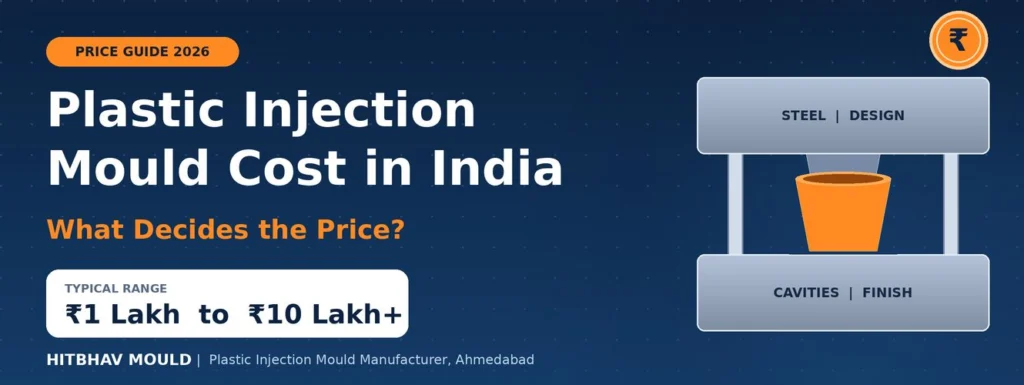
Short answer: a plastic injection mould in India costs anywhere from about ₹1 lakh for a small, simple mould to ₹10 lakh or more for a…