
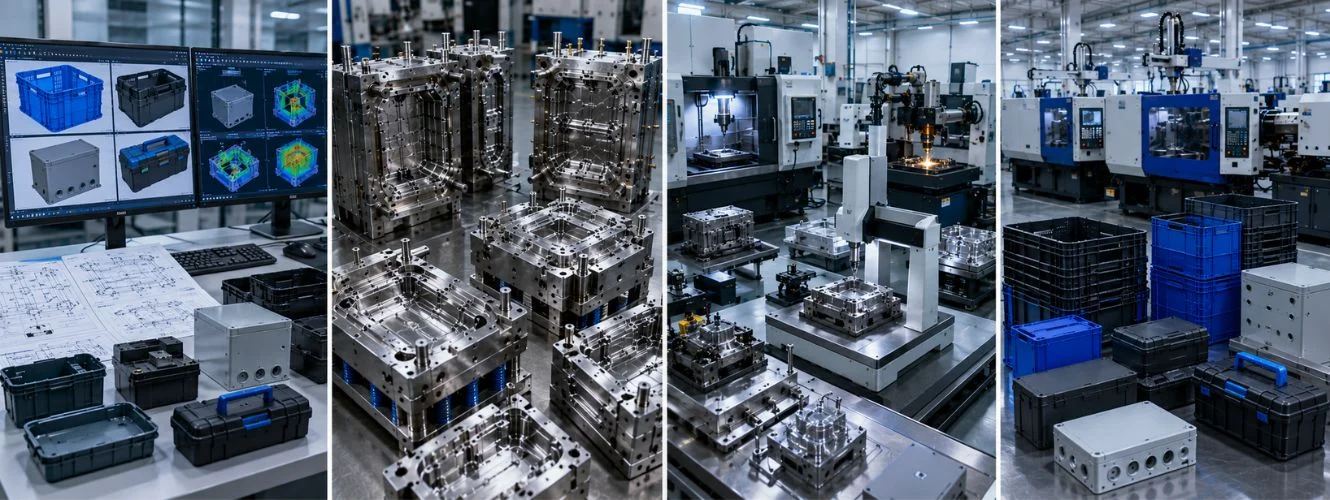
Industrial moulds face the toughest demands of any mould category: high pressure, abrasive materials, massive volumes, and zero tolerance for failure. Here are the eight most common challenges manufacturers face, and the proven engineering solutions that solve them.
An Industrial Plastic Mould is built to produce parts that hold up the rest of the world’s machinery crates that carry hundreds of kilograms, electrical switch boxes that protect live wiring, battery containers that must survive years of vibration and chemical exposure, and toolbox components that get dropped, stacked, and abused daily.
These products demand moulds that can run for hundreds of thousands of cycles, hold tight tolerances under high injection pressure, and produce parts that meet strict mechanical and safety standards every single time. It is, without question, the most demanding category of Plastic Injection Mould manufacturing and it is also where most things can go wrong if the mould is not engineered correctly from the start.
At Hitbhav Mould, a leading Plastic Injection Mould Manufacturer in Ahmedabad, we have built and repaired industrial moulds for crate manufacturers, electrical component makers, battery producers, and tool manufacturers across India. This guide covers the eight challenges we see most often in Industrial Product Mould manufacturing and the engineering solutions that actually fix them.
Challenge 1 – Premature cavity wear from abrasive materials
Premature cavity wear
The problem
Many industrial parts use glass-filled nylon, glass-filled PP, or other reinforced resins for added strength common in Tool Box Parts Moulds and structural components. These glass fibres act like sandpaper inside the mould, eroding cavity surfaces far faster than unfilled resins. Manufacturers using standard P20 steel mould often see visible wear and dimensional drift within 100,000 to 150,000 shots well short of the expected mould life.
The solution
Use H13 hardened tool steel with appropriate heat treatment to 48–52 HRC for any mould running glass-filled or mineral-filled resins. At Hitbhav Mould, we identify abrasive resin use during the DFM review and recommend the correct steel grade and surface treatment before machining begins, not after the mould is already wearing out.
Challenge 2 – Part warping and dimensional instability
Part warping after ejection
The problem
Large, flat, or thick-walled industrial parts like Plastic Crate Moulds and switch box moulds are highly prone to warping. Uneven cooling causes different sections of the part to shrink at different rates, resulting in bowed surfaces, twisted corners, and parts that fail to sit flat or assemble correctly with mating components.
The solution
The fix starts at the design stage uniform wall thickness throughout the part dramatically reduces uneven shrinkage. Beyond design, the mould’s cooling channel layout must be engineered to cool all sections of the cavity at the same rate, often requiring conformal cooling channels that follow the part’s contours rather than simple straight-line drilling. Controlled, slower ejection combined with a cooling fixture for large flat parts immediately after ejection can also lock in dimensional accuracy before the part fully solidifies.
Challenge 3 – Long cycle times limiting production output
Long cycle times
The problem
Industrial parts often have thick walls and large volumes of plastic to cool and cooling time is typically the largest portion of any injection moulding cycle. For high-volume products like Battery Container Moulds, even a few extra seconds per cycle compounds into a massive loss of output across a production shift.
The solution
Cooling channel design is one of the highest-value engineering decisions in any industrial mould. Channels should be positioned as close to the cavity surface as structurally possible, sized correctly for water flow rate, and arranged to avoid hot spots particularly around thick ribs, bosses, and corners where plastic mass is concentrated. At Hitbhav Mould, our mould design team simulates cooling layout before machining begins, optimising for the fastest safe cycle time without compromising part quality or mould durability.
Challenge 4 – Flash and burr requiring manual finishing
Flash and burr on parts
The problem
Flash thin excess plastic that escapes along the parting line is one of the most common defects in industrial moulding. It happens when the mould halves do not seal perfectly under injection pressure, often due to worn parting surfaces, insufficient clamping force, or excessive injection pressure.
The solution
Precision-ground parting surfaces with tight tolerance fits between mould halves are the first line of defence this is a machining quality issue that starts at the manufacturer’s tool room. Matching clamping tonnage correctly to the mould’s projected area prevents the mould from being forced open under pressure.
Challenge 5 – Cracked inserts under high injection pressure
Cracked mould inserts
The problem
Thin mould inserts and small core pins used to form holes, ribs, or fine features can crack under the repeated stress of high-pressure injection especially when running glass-filled or high-viscosity resins. A cracked insert means immediate production stoppage and an emergency repair, often at the worst possible time during a production run.
The solution
Insert geometry must be reviewed during DFM to identify thin or unsupported sections before they become a problem. Using premium tool steels like H13 or S136 for high-stress inserts, with correct heat treatment, dramatically improves fatigue resistance. Keeping critical spare inserts on hand, something Hitbhav Mould recommends and supplies for every industrial mould we build, minimises downtime if a crack does occur.
Challenge 6 – Inconsistent wall thickness causing weak parts
Inconsistent wall thickness
The problem
Industrial parts often need varying thickness for structural reasons, thicker at mounting points, thinner across large flat panels. Without careful design, these transitions create sink marks, internal voids, and weak points that fail under load, a serious issue for products like crates that must carry heavy loads repeatedly.
The solution
Wall thickness transitions should be gradual, never abrupt using ribs and gussets to add strength rather than simply thickening the wall, which causes sink marks and increases cycle time. Coring out thick sections wherever possible maintains structural integrity while keeping wall thickness uniform.
Challenge 7 – Difficulty meeting electrical and safety compliance
Compliance and safety standards
The problem
Products like Electrical Switch Box Moulds must meet strict IS and IEC standards for flame retardancy, dimensional accuracy for IP-rated sealing, and wall thickness for electrical insulation. A mould that does not account for these requirements from the start can produce parts that fail certification testing, an expensive and time-consuming setback discovered far too late in the process.
The solution
Compliance requirements must be built into the mould design from day one not retrofitted afterwards. At Hitbhav Mould, our engineers factor in the relevant IS/IEC standards during the DFM review for every electrical and industrial enclosure mould we design.
Challenge 8 – High mould cost with uncertain ROI
High mould cost, uncertain ROI
The problem
Industrial moulds, especially multi-cavity moulds in H13 steel for high-volume production represent a significant upfront investment. Many manufacturers either over-invest in tooling they do not yet need, or under-invest and find themselves re-tooling within a year as demand grows beyond what a budget mould can handle.
The solution
The right approach is to match mould investment to a realistic 2–3 year volume projection, not just current demand. At Hitbhav Mould, we walk every
Custom Plastic Mould client through this volume-versus-investment conversation honestly recommending what is right for your business stage, not what generates the largest invoice.
A pre-order checklist to avoid these challenges from day one
Why industrial manufacturers across India trust Hitbhav Mould
100% in-house manufacturing
CNC machining, EDM, heat treatment, and precision grinding all under one roof in Ahmedabad full quality control, no outsourced weak links.
DFM review on every project
Every industrial mould drawing is reviewed for wall thickness, cooling, material compatibility, and compliance before machining begins.
Cooling channel engineering
Optimised cooling layouts designed to minimise warping and reduce cycle time on every industrial mould we build.
T1 sample approval guaranteed
Real sample parts produced and tested on our in-house plastic injection moulding machine before your mould ships.
Correct steel grade, every time
P20, H13, or S136 selected based on your resin, pressure, and volume never one-size-fits-all tooling.
After-sales support and spares
Repair, refurbishment, and spare insert support for the full working life of every industrial mould minimal downtime, guaranteed.
Conclusion – every challenge in this guide is preventable
Cavity wear, warping, long cycle times, flash, cracked inserts, wall thickness failures, compliance issues, and uncertain ROI every single challenge covered in this guide has a proven engineering solution.
At Hitbhav Mould, we have built our entire process around getting it right the first time: DFM review, correct steel selection, engineered cooling, precision machining, and T1 sample approval before anything ships. As a trusted Plastic Injection Mould Manufacturer in Ahmedabad, we bring this discipline to every Industrial Plastic Mould we build.
Free engineering consultation
Facing one of these challenges? Let our engineers review your mould or product design
Share your product drawing, current mould issue, or production volume target. Our engineering team at Hitbhav Mould will identify the root cause and recommend a practical, cost-effective solution.